Quick update on the survey:
We have a good number (25) of results now, so I’ll be closing the survey at midnight UTC on Thursday. That means that the last day to fill out the form is Wednesday (in the morning if you’re in Argentina).
I’ll then synthesise the answers and share a summary here this Friday.
Edit: The survey is now closed. And the results are in!
Respondents
A total of 30 respondents filled out the survey. The vast majority of them were Orchestrators. The five respondents who did not self-identify as an Orchestrator all said they were Delegators. Among those, we had the two inc. team members, one builder, and two that only put Delegator.
Most Orchestrators also self-identified as Delegators. Eleven did not.
| Role |
Count |
| Orchestrator |
25 |
| Delegator |
19 |
| Liquid LPT holder |
2 |
| Builder/developer |
3 |
| Inc. team member |
2 |
| Community contributor |
1 |
Participation
Low and critical participation thresholds.
The following figure plots percentages against the number of respondents that, according to their responses, would consider a fall in currentBondingRate below that figure to be a concerning (blue) or critical (red) scenario.
All but two respondents would not find a bonding rate of as low as 40% a cause for concern in and of itself. Just over half said they would be OK with 30%. Opinions about “critically low” bonding rates are more spread out.
Reasons that low participation may be a cause for concern.
Several respondents admitted that they don’t know a definite reason that low participation would be a problem. The respondents that did state a definite reason had the following to say:
- Signals a holder community preoccupied with speculation rather than fundamentals. Lower participation means that a greater weight of LPT holders are skewed towards speculative activity rather than long-term engagement and commitment to the project. A rapid drop would be a signal that delegators are longer committed to the protocol, which is a problem. Too much LPT unstaked could lead to excessive selling pressure.
- Collateralising the service. Less security via stake available for slashing. (Note that slashing is not currently implemented, but it still may function as a signal of commitment to security.)
- Stake liquidity. If participation is too low, small stake movements would change the leaderboard too much, leading to difficulties for Orchestrators.
- Voting power concentration. If few tokens are staked and used in voting compared to those being actively traded, the DAO has limited defence against hostile governance actions.
- Signals generally bearish sentiment. Low participation could be taken as a signal of low interest in LPT-denominated yield.
Note. A significant fraction of respondents answered that low participation is undesirable “because it would lead to high inflation.” Since the intent of the question was to consider the protocol objectives for participation in isolation from the mechanism (adjusting emissions) used to achieve it, we cannot use these answers to establish principles for participation objectives. Next time we do a survey on this topic, we need to find a better wording that makes the intention clear to all respondents!
Reasons that high participation may be a cause for concern.
On the whole, respondents were far less sure about this question. Only 11 respondents answered that high participation is a problem, and even some of those seemed rather unsure of the conclusion.
- Liquidity crunch. Too large a part of LPT supply locked in stake would negatively impact liquidity, leading to price volatility and creating a barrier to entry for new entrants to accumulate stake. This was the most common reasoning, with eight respondents arguing this view.
- High participation does not guarantee high decentralization. In other words, the supposed benefits of high participation diminishes at high numbers.
- Optics. May resemble an unsustainable financial scheme where the only thing to do with the token is lock funds with expectancy of profit.
A few respondents gave numbers. The lowest number was 60%. Many answered 70, 80, or 90%. Since high participation does not appear to be a pressing concern, I didn’t spend much time analysing through these figures.
Collected additional remarks about bonding.
- I think the critical indicator is in the decentralization of token holders bonding, rather than the total tokens bonded.
- A system should be put in place to prevent overly abrupt upward or downward movements, and perhaps establish minimum and maximum thresholds.
Yield
What types of opportunity should be considered peers for the purpose of comparison with LPT staking?
Probably the most enlightening data to come out of this section are the responses to this question.
| Category |
Count |
| DePIN projects with staking |
26 |
| POS blockchains |
4 |
| DeFi products |
3 |
| DeFi products excl. stablecoin |
2 |
| Staking tokens with similar market cap |
15 |
| Similar TVL |
6 |
| Similar risk profile |
14 |
| Other: Similar tokenomics |
2 |
Key observations:
- By far the most popular category for comparison was DePIN projects with staking.
- DeFi products were not high on people’s lists for peer comparison.
- Two respondents called for comparison based on similar tokenomics. One argued that judging whether another project was suitable for peer comparison “really depends on the tokenomics/mechanism design of the protocol.” The other was more specific, asking that we compare with “fee generating protocols where delegator earnings are a combination of fees + inflationary token.”
Should Livepeer aim to reduce staking yield in order to improve the perception of LPT vis-à-vis its competitors? How close to that of its nearest competitor should Livepeer staking yield be in mid 2026? What about end of 2027?
The community is divided on this issue. The majority (22 of 29 respondents) did call for yield to be brought down. Twenty respondents wrote a number for mid 2026, and 18 wrote a number (11) or something along the lines of “close to nearest competitors” (7) for end of 2027. Given the difficulty of identifying which projects ought to be considered “peer competitors,” it is hard to assign concrete numeric targets for yield based on these responses. Nonetheless, they give us indications of the thinking of community members about how (or whether) Livepeer should compare its yield to that of other protocols.
Judging by the respondents (20) who gave a number, those who call for yield to be brought down believe it should be brought down sharply — many called for it to fall to within batting range of its best peer competitors already by mid-2026. For example, combining the highest numerical response (3x nearest competitor) with the upper limit of the range of yields quoted in the question for other DePIN projects would set the mid 2026 target yield at 45%, far lower than the rate of over 65% we see today. If we adopt a more conservative picture of DePIN yields available elsewhere, we are led to interpret many of the answers as calling for yields of well under 30%. (Due to the complexity of the question, these calculations ought to be taken with a grain of salt.)
A significant minority were either unsure (3) or entirely against (5) the idea that bringing down yield is a goal at all. (We identified a respondent as entirely against the idea of lowering yield as a target if they expressed a negative opinion about it and left the numeric target questions blank.)
What were the main objections to lowering yield as an objective? Subject to varying levels of paraphrasing and aggregation, here are some of the common themes that came up in the responses:
- The system is functioning as intended. We should let the market forces do their work, and emissions will come down naturally with increased participation.
- High yield can be a valid part of a financial or GTM strategy. It is not necessarily a problem in and of itself.
- Setting a specific numeric target is wrong. We should ask more fundamental questions such as how many LPT is the protocol “paying” to whom for what?
- Would a significant drop in the yield rate really guarantee a meaningful increase in the token’s market value?
- This question/section seems to be treating LPT as a currency. For as long as I’ve been involved in this project, it’s been stressed that LPT is a work token.
- This question/section considers only “nominal” yield and does not take into account dilution. LPT rewards are not directly comparable with stable-denominated DeFi yields that are not subject to dilution.
Budget
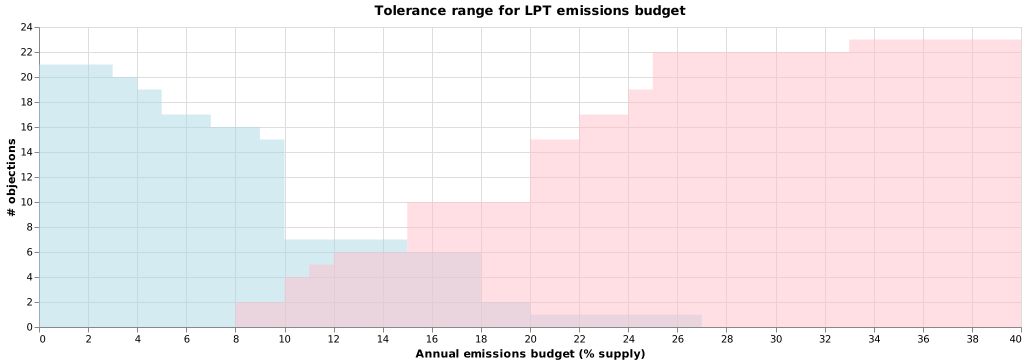
As a percentage of market cap, how much should Livepeer aim to spend on across-the-board stake subsidy in 2026?
The answers to this question were quite wide-ranging, and even the least objectionable figures were considered too low by some respondents and too high by others. Given the proximity of the question to complex issues of targeted redistribution and budget, the diversity of responses is unsurprising.
In terms of minimising the absolute number of objections, a target range of 10–15% stands out as least unpopular. To achieve this figure in 2026 would require inflation to come down rather sharply. For example, if emissions were to trend down in every single round from now until the end of next year, the rate of change would have to be increased by a factor of at least 2.7x, corresponding to a setting of inflationChange = 1350, to achieve a net annual emissions of less than 15%. Of course, with any setting of targetBondingRate close to the current value, it is far from guaranteed that emissions will decrease in every single round.
Other notes about the data:
- We received 24 responses to this question. Five respondents abstained.
- One respondent wrote 75%. If taken literally, it’s unlikely to be possible to satisfy. I dropped it from the data when plotting the graph.
- Three respondents gave a single figure instead of a range. To plot this on the graph, I adopted the assumption that those respondents would not object to a final emissions budget within ±10% of the given figure.
Clarification. The framing used in the question presents the annual emissions rate — the percentage of supply at year end that was newly issued during that year — as an expenditure on subsidising staking. This framing does not capture the full picture of a nuanced topic. It’s perhaps clearer to say, for example, that over the course of 2025, 24% of unstaked supply will have been redistributed, via dilution, to Orchestrators and Delegators. With participation around 50%, that means around 12% of the total supply is being redistributed; equivalent to roughly $24M if priced at todays market cap.
Collected remarks about budget and what it should be spent on.
Respondents expressed a wish for emissions to go to Os that invest into actively providing a high quality transcoding or AI service (3 respondents), or to redirect them to the treasury to fund other programmes (1 response). One respondent asked for more transparency about how treasury funds — which when they were actively being replenished, were funded by emissions — are being used.
- Stake should go to Os that do real work.
- I’d like to have a bit more visibility on how and where the funding has gone and how it’s being used. It kinda gets lost sometimes and not easily trackable.
- Give less of it to delegators / orchestrators, give more of it to treasury and fund innovation.
Summarised general comments about the emissions mechanism as a whole.
- Half of the Livepeer token supply is unbonded and I think we need to ask ourselves why. Why are unstaked LPT holders not delegating despite high yield?
- I don’t like the free money aspect of LPT inflation. I once said that if we ever reach 100M LPT in market cap and we still are unsustainable in ETH fees, maybe there’s just no market for LPT.
- Fees from PMF solves all the problems. We wouldn’t even be talking about this if we had plenty of revenue from fee-paying customers.